Content

Showing posts with label Asia. Show all posts

Shipbreaking Yards of Alang, Gujarat (India)

Wednesday, 4 June 2014

From chapter 2 of the book “Elegance and Dignity – Stories from India”


Alang is the largest ship recycling yard in the world, a kilometres-long expanse of sites where gigantic carcasses of ships are waiting to be disassembled by hand-workers, who recycle parts and components. Here are employed about 40000 workers, as much as a medium town. It’s a dirty, dangerous, exhausting and deadly job. They climb on these metal giants that stay torn apart and half-cut into the sea. They handle oxyhydrogen flames throughout the day, the air is unbreathable and saturated of combustion gasses, of oils, lubricants and acid fumes, the air is pungent, stinging, it burns the eyes and the nose. Here as elsewhere the workers are poor labourers coming from agricultural areas even poorer than here, like Bihar, Assam, Orissa, West Bengal or the neighbouring Pakistan, they flee from hunger, do not have any formal training to deal with toxic materials, are willing to make this life for the equivalent of a few euros per day. For this little money they are daily exposed to arsenic, lead, contaminated by asbestos, all of which under deafening noise. In the closer village people live by sheep farming and by a related industry (recovery and distribution of spare functioning pieces of the ships). It’s like stepping back 200 years when you exit the shipyards and visit the village. But even here the pollution is terribly high.


Scrap materials, however, are a big business and thanks to cheap Indian labourers a too little costly one, and these environmental risks are not taken into any account. India, Bangladesh, Pakistan, China and Turkey are the homes of the world’s shipbreaking facilities. Every year the shipping industry sends around 600 ships of all types to be dismantled on their beaches. Workers here are totally unqualified, having very little education and are thus easy to be exploited. Workers are being provided neither with the adequate training nor with the equipment to work in such a dangerous and toxic environment, although shipbreaking is considered by the International Labour Organisation as one of the heaviest and most hazardous occupations in the world. Their general living conditions after migrating to the yards are extremely bad. Every year thousands of workers are the victims of deadly accidents at the yards of India, Bangladesh and other shipbreaking countries. The working conditions are extremely bad and safety measures hardly exist. If the shipbreaking workers don’t die or get seriously injured because of an accident, they suffer a big risk of falling ill or dying from toxic waste-related diseases.

BUY PICTURES FOR EDITORIAL USE / PRINTS


© 2013 Marco Palladino – All rights reserved

beach, broken, cargo, chunks, container, corrosion, damaged, discarded, disposal, dump, environment, environmental, freight, garbage, goods, heap, indonesia, industry, iron, junk, junkyard, lombok, metal, ocean, pile, pollution, polution, recycle, recycling, reuse, rust, rusty, scrap, scrap-iron, ship, shipping, stack, steel, traditional, transport, transportation, trash, ugly, utilize, waste, wreck, wreckage, yard, pollution

BUY PICTURES - COLOUR VERSIONBUY PICTURES - B&W VERSION
BUY PICTURES FOR EDITORIAL USE / PRINTS


YOU CAN HELP THIS PROJECT TO CONTINUE
AND TO BE SHOWN TO A WIDER AUDIENCE
FUNDRAISING IS ESSENTIAL TO SUPPORT FREELANCE PHOTOJOURNALISM


READ ALL >>>

INDIA - Preindustrial Villages of Rajasthan

Thursday, 29 May 2014

    Here we present the synopsis from chapter 6 of the book “Elegance and Dignity – Stories from India”


FULL-RES EDITORIAL PHOTOS  >>

India today exists on a multiple level including high industrialization and traditional farming communities, and this leads to a growing social gap. Talking about preindustrial society would make more than a historian upset, but this is exactly what is to be seen. Farming communities that are still in the preindustrial era, which do not know the use of machines to work in the fields and do not participate to modern life. These villages are obviously not impenetrable by modernity, which comes in the form of objects that elsewhere would be considered trash or waste. They don’t ignore what is in their surroundings. Their culture and way of life, however, are anchored to a preindustrial scheme and so are traditions, familiar and social networks, so the rules of the village and the religious codes. The people of these villages are not educated nor culturally prepared to face the challenges of the modern world in which they are increasingly going in contact. They are not able to understand the choices made at the top, by the governments, nor to politically organize themselves as a pressure group, despite the democratic principle guaranteed by the Indian system: “one man, one vote.” These communities suffer more than others the strong government interferences as a mediator of the multinational enterprises that would induce villagers to abandon traditional sustainable farming and to adopt intensive farming and OGMs. There is an invisible struggle that these villages face every day against very powerful enemies.


Despite being a desert region, Rajasthan is an area where water is abundant due to the monsoons. In the centuries the need to manage a resource on a seasonal base has created a true culture for water that is not only declined in the sacredness by which in this country waterways are venerated but also and especially into complex hydraulic systems that already the British did not completely understand and let them deteriorate. Rain is also called ‘megaphusp’ (flower of clouds) and there are at least 25 names that refer to as many hydraulic systems for irrigation and drinking water and made Rajasthan the most flourishing desert on earth. Throughout its ancient history there is not a single description of this desert as a barren and desolate land. Obviously these systems do not require electric pumps or fuel and allow villages that have preserved them to overcome the drought affecting on contrary the “modernized” villages. Traditional crops and irrigation systems have been first attacked by the so-called “green revolution”, which included monocultures of species that require a lot of water, fertilizers and pesticides; then by the large water constructions, financed by the World Bank, that have depleted aquifers. People travel miles to find a source of drinking water and it is a tragic reality that someone at home opens the taps and in a few minutes consume as much water as during one of those trips.


© 2013 Marco Palladino – all rights reserved

agriculture, Asian, beautiful, blue, building, cattle, clothing, colour, cultural, culture, destination, drinking, eco, ethnic, ethnicity, farming, greenery, head, headshot, herd, hill, Hindu, horizontal, house, India, Indian, jewellery, landscape, mountain, nature, outdoor, people, person, pond, poor, portrait, poverty, Rajasthan, rural, saree, sari, scenery, signs, tradition, traditional, tranquil, travel, tribal, tribe, valley, veil, village, water, watering, wilderness, woman


YOU CAN HELP THIS PROJECT TO CONTINUE
AND TO BE SHOWN TO A WIDER AUDIENCE
FUNDRAISING IS ESSENTIAL TO SUPPORT FREELANCE PHOTOJOURNALISM

READ ALL >>>

The Slums of Mumbai. Urban Issues or Functional Networks?

Wednesday, 5 February 2014


   Here we present the synopsis from chapter 1 of the book “Elegance and Dignity – Stories from India”


FULL-RES EDITORIAL PHOTOS  >>

   The inequalities generated by our global economic system seem nowhere as visible as in the megacities of South Asia, Latin America, and Africa, where decades of foreign and domestic investment in real estate have produced globalized cityscapes in parts of the city, while others remain entrenched in supposedly pre-modern living conditions. This produces, almost by default, the vague category of the “slum”, which becomes self-referential to nearly everything that falls outside the ambit of the high-rise, modern city.

   Mumbai is the place where the greatest democracy of the world shapes its new myths of modernity and suffers with it the silent multitude of the miserable. It’s a modern and dynamic city, the largest and richest among the Indian cities, the city where half of the population does not have a house. In its typical image, the capital city is made of modern buildings that stand like islands of modernity in a dark sea of slums. There is a prevailing perception that apart from its southernmost colonial quarters, Mumbai is essentially a schizophrenic urbanscape where emergent islands of modernity are surrounded by an endless sea of informal shacks. This image of a city sharply divided between opulence and poverty is used across the political spectrum to justify redevelopment projects in the name of equality.

   The true Gateway of India is its impressive net of slums spread along the railway lines, or in the neighbourhood of Dharavi, the largest slum of all Asia, which is less than a mile from Bandra West, the most chic district of Bombay, where the stars of Bollywood live. The so-called slums come from a long history related to migration flows. The first economically and culturally marginalized caste groups migrated in the 1930s - from the southern regions of the country - to this unused, marshy, mosquito-infested territory adjoining a centuries-old fishing village.


   Shacks, huts, shelters, built with everything except the materials that are used for construction. Shelters that do not repair, which do not keep you warm or cool, which are useless apart from the illusion of a firm foothold on this sea of garbage. But they do respond to a precise history, that shaped the network. The habitats of Mumbai have traditionally been as diverse and heterogeneous as the city’s migratory flows. Coastal fishing villages, vernacular urban structures, grand colonial monuments, contemporary bungalows, working-class barrack-like enclaves, and modern apartment blocks have jostled for space on this tiny island through the eighteenth, nineteenth, and early twentieth centuries. However, in spite of this diversity, Mumbai is usually reduced to three broad urban archetypes: the historical city, the slum, and the high-rise.

   In Mumbai, the high-rise building, that ubiquitous symbol of modernization and the ultimate architectural affirmation of middle-class status, is typically presented as the answer to the organically developing, unplanned, low-rise, hyperdense, and slum settlements that are said to house 60 percent of the city’s residents. The Dharavi Redevelopment Project (DRP) and the Slum Rehabilitation Scheme (SRS) projects, conducted by the government of Maharashtra, have for long pioneered the provision of housing to the poor by private developers. Only 35% of the slum dwellers seem to be eligible for the project and the government has not considered 35,000 families living on lofts and first floors. The scheme allows private developers to redevelop slum pockets with the consent of 70 percent of the “eligible slum dwellers” living in that pocket, in exchange for construction rights in more valuable parts of the city. Many faces of Bombay coexist without overlapping, from Dharavi slum up to the largest monument to modernity, a bridge of six kilometres (see above) that connects the richest parts of the city otherwise separated by the sea or the slums.   

   Above all a dusty, yellowish polluted wet air.


© 2013 text and photos by Marco Palladino all rights reserved


abandoned, apartment, apartments, architecture, area, block, brick, broken, building, buildings, cities, city, color, concrete, construction, debris, demolition, destruction, dilapidated, dirty, downtown, dump, facade, garbage, ghetto, grunge, home, house, houses, housing, hut, industrial, inner-city, life, living, obsolete, old, poor, poverty, shack, shacks, slum, slums, town, urban, walls, weathered


YOU CAN HELP THIS PROJECT TO CONTINUE
AND TO BE BROUGHT TO A WIDER AUDIENCE
FUNDRAISING IS ESSENTIAL TO SUPPORT FREELANCE PHOTOJOURNALISM


READ ALL >>>

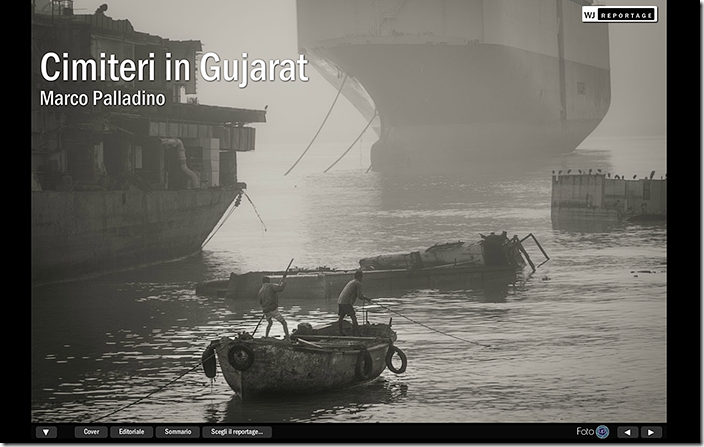
Naval Cemeteries of Gujarat (India). Photo Reportage in Witness Journal Issue #59

Wednesday, 15 January 2014

Alang is the largest ship recycling yard in the world, a kilometres-long expanse of sites where gigantic carcasses of ships are waiting to be disassembled by hand-workers, who recycle parts and components. Here are employed about 40000 workers, as much as a medium town. It’s a dirty, dangerous, exhausting and deadly job. They climb on these metal giants that stay torn apart and half-cut into the sea. They handle oxyhydrogen flames throughout the day, the air is unbreathable and saturated of combustion gasses, of oils, lubricants and acid fumes, the air is pungent, stinging, it burns the eyes and the nose. Here as elsewhere the workers are poor labourers coming from agricultural areas even poorer than here, like Bihar, Assam, Orissa, West Bengal or the neighbouring Pakistan, they flee from hunger, do not have any formal training to deal with toxic materials, are willing to make this life for the equivalent of a few euros per day…>> READ THE REPORTAGE IN WITNESS JOURNAL #59 >>

image

beach, broken, cargo, chunks, container, corrosion, damaged, discarded, disposal, dump, environment, environmental, freight, garbage, goods, heap, indonesia, industry, iron, junk, junkyard, , metal, ocean, pile, pollution, pollution, recycle, recycling, reuse, rust, rusty, scrap, scrap-iron, ship, shipping, stack, steel, traditional, transport, transportation, trash, ugly, utilize, waste, wreck, wreckage, yard

READ ALL >>>

Pollution and overfishing damaging the villages of fisher(wo)men in Gujarat (India)

Sunday, 8 December 2013


From chapter 4 of the book “Elegance and Dignity – Stories from India”


This is another Indian story, extracted from my book “Elegance and Dignity”, that connects tradition with modernity, but not in agricultural areas rather in the sea. These fishing villages of Gujarat, where the whole community receives sustenance from fishing, are seriously threatened by the invasion of foreign ships that make large industrial fishing. The number of species and quantity of fish are in drastic decline since several years. The community depends on this activity: as narrated by the images the men go to sea with boats often no bigger than a lifeboat, women take care of the drying process.

Once again there is an aesthetic, which also contains the goodness of these simple lifestyles. It is an hard work but very decent. The community participates in solidarity and women portrayed here have serene faces and keep goofing around while they work.

The pollution of the sea, along with overfishing are, not so slowly, impoverishing these villages of their only resource. The repercussions are also at a social level, many young people are forced to emigrate. They can not get married, families slowly disperse. Some of them will go to work as cheap laborers in various industries of Gujarat, some to sites like Alang. Children, like many others I portrayed in different parts of India, already have a strenuous work to accomplish inside the community of fishermen, in this village it is the drying of fishes, while the men are at sea.
 
Overfishing, destructive and unsustainable fishing practices are some of the main causes of the collapse of fish populations: gigantic ships using km-wide nets and machines that literally exhaust entire shoals of fish. These industrial fishing extinguishes a species at a time, then turning to the next species.
 
Rising temperatures and ocean acidification are two threats to ocean life resulting from industrial development, with increased levels of carbon dioxide as a result of reliance on fossil fuels.
 
The pollution is widespread in all the oceans. All types of pollutants generated are degrading the marine environment, not just those emitted by factories, but as well by pesticides and nutrients from agriculture, as well as sewage, plastics, toxic chemicals and oils derived from discharges, even from radioactive nuclear power plants, located near the coast.
 
Along with the environment, all eco-friendly traditional fishing communities are losing the ability to self-sustain. They ere increasingly turning to small fish species, such as the photos and the fishermen of Jafrabat refer.


©2013 Marco Palladino – All rights reserved


IMG_0075

READ ALL >>>

Indian Portraits. From Stories recorded in Gujarat, Rajasthan, Karnataka. Preview

Monday, 29 July 2013

In January and February of 2013 I made a long journey to India in search of stories through which to tell a much visited country under a new light and in my opinion a more true one. It was the period of the Maha Kumbh Mela and I started with the desire to go to this huge religious festival, like my colleagues, to capture one of the most beautiful mass rituals of the modern age. The fate instead led me elsewhere.


I discovered the Gujarat, very little kwown by tourists and I was able to photograph an India that is very different from that illustrated on the postcards. At short a book will be published (both English and Italian) containing eight reportages and various littler stories. After that I’ll publish the photos. But here's a preview that collects portraits, excerpts from stories that will be illustrated in the book. Good vision.


IMG_8972

GO TO THE ARCHIVE

READ ALL >>>

Ladakh, Little Tibet of India. Radical changes of environment and social standards

Thursday, 10 January 2013

Text and photos by M.Palladino(Modus Vivendi nr.50 December 2003)

Ladakh

A Valley in the centre of Himalaya.
Leh is the capital of a vast western region of Tibet - currently within the farthest reaches of the Indian republic - which takes its name from two contiguous areas, Ladakh and Zanskar (name of the river), whose civilization has developed over the centuries along the course of the high Indus and of its tributaries, which have carved a multitude of fertile valleys here at incredible heights. You get to the capital on roads going from Srinagar, if not choosing for the airplane, leaving by bus from Manali (Himachal Pradesh).
READ ALL >>>

La Cina moderna e il rischio ecologico. Indagine e reportage sul paese-continente protagonista della nuova globalizzazione mercantile.

Wednesday, 2 January 2013

La bottega di Confucio.

di Marco Palladino

da Modus Vivendi Nr.43 Aprile 2003
SCARICA PDF ARTICOLO STAMPABILE

pagina1

“A distanza di 10 anni da questo reportage che scrissi a seguito di una lunga permanenza nel “continente” Cina, dal 2000 al 2001, e iniziando una serie di retrospettive sul lavoro giornalistico svolto anni orsono…fa impressione vedere che non è cambiato assolutamente niente. Questo reportage avrei potuto scriverlo ieri…”

SOMMARIO. Le norme sociali di una società contadina che consuma l’essenziale e pone le ricchezze prodotte a beneficio del gruppo potrebbero salvare la Cina da un disastro annunciato. Nonostante gli attacchi del maoismo alle tradizioni feudali, certi condizionamenti sociali hanno resistito e si sono rinnovati nell’ideologia nazionalista: lo spreco e l’accaparramento anzi banditi più che mai. Se l’industrializzazione è avvenuta a tappe forzate e saccheggiando come mai prima le risorse ambientali, la vera minaccia deriva dal nuovo corso economico iniziato da Deng Xiaoping e attualmente al suo culmine. Il “glorioso arricchirsi” ha sostituito la solidarietà di clan, e le nuove, ancor più anonime città mercantili ospitano sempre più individui e sempre meno gruppi familiari. I mercati internazionali, con l’ingresso della Cina nell’OMC, spingono ad aumentare la produzione, per garantire quell’arricchimento che solo potrà compensare le mutazioni violente in seno alla società e per competere sullo stesso piano con l’occidente e il suo stile di vita assolutamente disastroso.

READ ALL >>>

Family Portrait – Arab Matriarchy in Midyat, East Anatolia

Friday, 28 September 2012

_MG_2225


In a city of Kurdistan, Midyat, in south-eastern borders of Turkey, there are the remains of a Christian Aramaic community.  This was until a few years ago crossroad of peoples and cultures, since many centuries, and only recently the latest influx of people of Arab culture have replaced (often by force) the Christian communities.

READ ALL >>>

The Sacred Mountains of the North. Reportage from Wutai Shan in northern China, looking for the remaining monks of Shanxi

Wednesday, 26 September 2012

ENGLISH TEXT BELOW

Le sacre montagne del Nord. 
Che cosa rimane dei luoghi sacri nella Cina odierna

Reportage dal Wutai Shan, nella Cina settentrionale
(estratto dal libro: La Terra Sospesa, storia di un viaggio in Cina, 297pp. Roma 2002)

di Marco Palladino

wutai

Il Wu Tai, nella provincia settentrionale dello Shanxi, è una delle quattro montagne considerate sacre dal buddismo. Altre cinque nel resto della Cina settentrionale, altrettanto famose, sono consacrate al Taoismo. Anticamente luoghi come questi erano destinati a profonda venerazione perché si riteneva che qui dimorassero gli dèi; più esattamente, le montagne stesse avevano nomi divini, erano dèi esse stesse, assimilate a entità viventi e perciò strettamente vincolate alle necessità dell’uomo, secondo il consueto rispecchiamento cinese dell’ordine sociale su quello naturale e cosmico. All’origine di tutto ci fu probabilmente la venerazione di una qualche Dea Madre Primigenia, come la Regina Madre dell’Ovest che si credeva abitasse il sacro monte Kunlun, nel Sichuan. Una matriarca che dominava sulle altre deità femminili ed era all’origine delle primissime credenze del taoismo religioso. Un’ipostasi di quella parte femminile associata all’energia yin da cui si genererebbe dinamicamente il divenire del mondo.

READ ALL >>>

Istanbul – Taksim, Sultanahmet and Minorities

Friday, 6 July 2012

The report presents shots from Istanbul, from the business district around the Taksim Square, the more modern soul of the city, where the boulevards are virtually identical to those of any other European city, with the usual shops of famous brands and multinational chains; and shots from the alleys of the old city, still not completely modernized.
Wherever, young fashionable clothes alternate with veiled women or even completely covered. On this street it is also the heart of the youth counter-culture and the headquarter of the cultural association of the Kurds.

The district behind Sultanahmet, the historic centre of Istanbul, still breathes the atmosphere of the old city and especially there you meet a representation of all minorities in this country, both in the ethnic sense and socially. It’s a neighbourhood totally abandoned by the institutions likely in view of a series of speculations for "revalue" it for tourism, but in the meantime the people here live and work on the street and welcome you with incredible warmth intensity, despite being very poor.


BUY PICTURES
BUY PICTURES FOR EDITORIAL USE


READ ALL >>>

Hasankeyf – Ancient City of Mesopotamia with Kurd Minorities

In the heart of Anatolia, there is a village of Hittite origin, Hasankeyf, a jewel with historic ruins of great value currently inhabited by a mostly Kurdish population.

The intense faces of the women in this age-old place, where life seems identical to hundreds of years ago, is what perhaps mostly impresses even more than the landscape itself, also very intense.

Hasankeyf, as well as other historic sites on the Tigris, will be flooded due to the construction of yet another dam built by a central power sadly addicted to magnify the national pride with buildings that are so monumental and costly as unnecessary and harmful. Its population is obviously going to be displaced.


Nel cuore dell'Anatolia, c'è un villaggio di origine ittita, Hasankeyf, un gioiello con rovine storiche di grande pregio attualmente abitato da una popolazione prevalentemente curda.

I volti intensi delle donne di questo luogo millenario, dove la vita sembra identica a centinaia di anni fa, mi hanno colpito forse più del paesaggio stesso, pure assai bello.

Hasankeyf, così come altri luoghi storici sul Tigri, verrà inondata a causa della costruzione dell'ennesima diga voluta da un potere centrale tristemente dedito a magnificare l'orgoglio nazionale con opere tanto monumentali e costose quanto inutili e dannose. La sua popolazione ovviamente verrà sfollata.


READ ALL >>>

Contact Form

Name

Email *

Message *