Content

Showing posts with label B&W. Show all posts

Shipbreaking Yards of Alang, Gujarat (India)

Wednesday, 4 June 2014

From chapter 2 of the book “Elegance and Dignity – Stories from India”


Alang is the largest ship recycling yard in the world, a kilometres-long expanse of sites where gigantic carcasses of ships are waiting to be disassembled by hand-workers, who recycle parts and components. Here are employed about 40000 workers, as much as a medium town. It’s a dirty, dangerous, exhausting and deadly job. They climb on these metal giants that stay torn apart and half-cut into the sea. They handle oxyhydrogen flames throughout the day, the air is unbreathable and saturated of combustion gasses, of oils, lubricants and acid fumes, the air is pungent, stinging, it burns the eyes and the nose. Here as elsewhere the workers are poor labourers coming from agricultural areas even poorer than here, like Bihar, Assam, Orissa, West Bengal or the neighbouring Pakistan, they flee from hunger, do not have any formal training to deal with toxic materials, are willing to make this life for the equivalent of a few euros per day. For this little money they are daily exposed to arsenic, lead, contaminated by asbestos, all of which under deafening noise. In the closer village people live by sheep farming and by a related industry (recovery and distribution of spare functioning pieces of the ships). It’s like stepping back 200 years when you exit the shipyards and visit the village. But even here the pollution is terribly high.


Scrap materials, however, are a big business and thanks to cheap Indian labourers a too little costly one, and these environmental risks are not taken into any account. India, Bangladesh, Pakistan, China and Turkey are the homes of the world’s shipbreaking facilities. Every year the shipping industry sends around 600 ships of all types to be dismantled on their beaches. Workers here are totally unqualified, having very little education and are thus easy to be exploited. Workers are being provided neither with the adequate training nor with the equipment to work in such a dangerous and toxic environment, although shipbreaking is considered by the International Labour Organisation as one of the heaviest and most hazardous occupations in the world. Their general living conditions after migrating to the yards are extremely bad. Every year thousands of workers are the victims of deadly accidents at the yards of India, Bangladesh and other shipbreaking countries. The working conditions are extremely bad and safety measures hardly exist. If the shipbreaking workers don’t die or get seriously injured because of an accident, they suffer a big risk of falling ill or dying from toxic waste-related diseases.

BUY PICTURES FOR EDITORIAL USE / PRINTS


© 2013 Marco Palladino – All rights reserved

beach, broken, cargo, chunks, container, corrosion, damaged, discarded, disposal, dump, environment, environmental, freight, garbage, goods, heap, indonesia, industry, iron, junk, junkyard, lombok, metal, ocean, pile, pollution, polution, recycle, recycling, reuse, rust, rusty, scrap, scrap-iron, ship, shipping, stack, steel, traditional, transport, transportation, trash, ugly, utilize, waste, wreck, wreckage, yard, pollution

BUY PICTURES - COLOUR VERSIONBUY PICTURES - B&W VERSION
BUY PICTURES FOR EDITORIAL USE / PRINTS


YOU CAN HELP THIS PROJECT TO CONTINUE
AND TO BE SHOWN TO A WIDER AUDIENCE
FUNDRAISING IS ESSENTIAL TO SUPPORT FREELANCE PHOTOJOURNALISM

READ ALL >>>

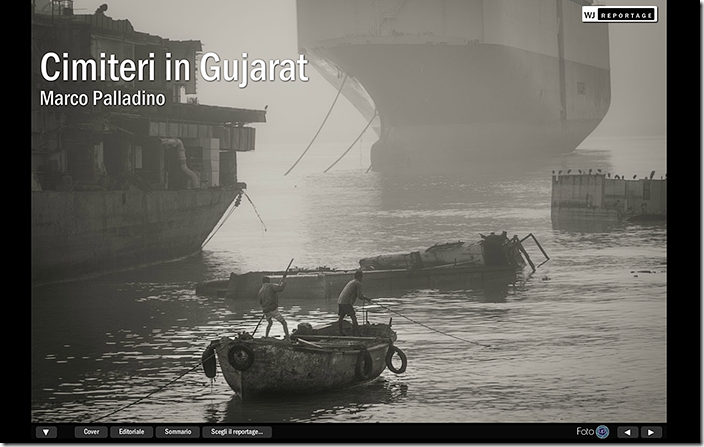
Naval Cemeteries of Gujarat (India). Photo Reportage in Witness Journal Issue #59

Wednesday, 15 January 2014

Alang is the largest ship recycling yard in the world, a kilometres-long expanse of sites where gigantic carcasses of ships are waiting to be disassembled by hand-workers, who recycle parts and components. Here are employed about 40000 workers, as much as a medium town. It’s a dirty, dangerous, exhausting and deadly job. They climb on these metal giants that stay torn apart and half-cut into the sea. They handle oxyhydrogen flames throughout the day, the air is unbreathable and saturated of combustion gasses, of oils, lubricants and acid fumes, the air is pungent, stinging, it burns the eyes and the nose. Here as elsewhere the workers are poor labourers coming from agricultural areas even poorer than here, like Bihar, Assam, Orissa, West Bengal or the neighbouring Pakistan, they flee from hunger, do not have any formal training to deal with toxic materials, are willing to make this life for the equivalent of a few euros per day…>> READ THE REPORTAGE IN WITNESS JOURNAL #59 >>

image

beach, broken, cargo, chunks, container, corrosion, damaged, discarded, disposal, dump, environment, environmental, freight, garbage, goods, heap, indonesia, industry, iron, junk, junkyard, , metal, ocean, pile, pollution, pollution, recycle, recycling, reuse, rust, rusty, scrap, scrap-iron, ship, shipping, stack, steel, traditional, transport, transportation, trash, ugly, utilize, waste, wreck, wreckage, yard

READ ALL >>>

Pollution and overfishing damaging the villages of fisher(wo)men in Gujarat (India)

Sunday, 8 December 2013


From chapter 4 of the book “Elegance and Dignity – Stories from India”


This is another Indian story, extracted from my book “Elegance and Dignity”, that connects tradition with modernity, but not in agricultural areas rather in the sea. These fishing villages of Gujarat, where the whole community receives sustenance from fishing, are seriously threatened by the invasion of foreign ships that make large industrial fishing. The number of species and quantity of fish are in drastic decline since several years. The community depends on this activity: as narrated by the images the men go to sea with boats often no bigger than a lifeboat, women take care of the drying process.

Once again there is an aesthetic, which also contains the goodness of these simple lifestyles. It is an hard work but very decent. The community participates in solidarity and women portrayed here have serene faces and keep goofing around while they work.

The pollution of the sea, along with overfishing are, not so slowly, impoverishing these villages of their only resource. The repercussions are also at a social level, many young people are forced to emigrate. They can not get married, families slowly disperse. Some of them will go to work as cheap laborers in various industries of Gujarat, some to sites like Alang. Children, like many others I portrayed in different parts of India, already have a strenuous work to accomplish inside the community of fishermen, in this village it is the drying of fishes, while the men are at sea.
 
Overfishing, destructive and unsustainable fishing practices are some of the main causes of the collapse of fish populations: gigantic ships using km-wide nets and machines that literally exhaust entire shoals of fish. These industrial fishing extinguishes a species at a time, then turning to the next species.
 
Rising temperatures and ocean acidification are two threats to ocean life resulting from industrial development, with increased levels of carbon dioxide as a result of reliance on fossil fuels.
 
The pollution is widespread in all the oceans. All types of pollutants generated are degrading the marine environment, not just those emitted by factories, but as well by pesticides and nutrients from agriculture, as well as sewage, plastics, toxic chemicals and oils derived from discharges, even from radioactive nuclear power plants, located near the coast.
 
Along with the environment, all eco-friendly traditional fishing communities are losing the ability to self-sustain. They ere increasingly turning to small fish species, such as the photos and the fishermen of Jafrabat refer.


©2013 Marco Palladino – All rights reserved


IMG_0075

READ ALL >>>

VIVIAN MAIER, A baby-sitter storyteller of America ‘900

Wednesday, 31 July 2013
Self-portrait, Feb 1955 (www.vivianmaier.com)Sometimes between oblivion and fame there is just an ordinary event. It was the year 2007, and during an auction, for a few hundred dollars, Mr. John Maloof, bought something like 40,000 negatives of unpublished images. Shots made by a nanny between the '50s and '80s, that narrate life of people living in the largest American cities streets.
READ ALL >>>

Indian Portraits. From Stories recorded in Gujarat, Rajasthan, Karnataka. Preview

Monday, 29 July 2013

In January and February of 2013 I made a long journey to India in search of stories through which to tell a much visited country under a new light and in my opinion a more true one. It was the period of the Maha Kumbh Mela and I started with the desire to go to this huge religious festival, like my colleagues, to capture one of the most beautiful mass rituals of the modern age. The fate instead led me elsewhere.


I discovered the Gujarat, very little kwown by tourists and I was able to photograph an India that is very different from that illustrated on the postcards. At short a book will be published (both English and Italian) containing eight reportages and various littler stories. After that I’ll publish the photos. But here's a preview that collects portraits, excerpts from stories that will be illustrated in the book. Good vision.


IMG_8972

GO TO THE ARCHIVE

READ ALL >>>

What a beautiful picture ... Photoshop did it? About post-production and retouch.

Thursday, 30 May 2013

ARTICOLO IN ITALIANO >>

What a beautiful picture, who knows what treatments you have made in Photoshop? Willy-nilly any photographer is today confronted with such questions. Just think about the winner photo of the World Press Photo Award 2013, the beautiful photograph of Paul Hansen, that has aroused so many reactions, as it should be, the vast majority however addressed to the editing, that many have considered excessive, and once again all complaints against the photographer, who is guilty according to many of creating drama in picture out of retouching, with an almost painterly use of light and color, definitely got in a fake way, according to many critics.

READ ALL >>>

Contact Form

Name

Email *

Message *