Content

Showing posts with label EOS 5D Mark2. Show all posts

Elegance and Dignity – Stories from India. Book preview and buy in Google Books

Friday, 11 April 2014

The humble people, the poor, the exploited ones, are the bearers of great dignity . They embody the full meaning of this word, because they live in a world where dignity is not easily achieved.

Elegance and Dignity by Marco Palladino is made of 10 photo stories across India and goes through the recent industrial development, tells about the labour and poor classes, and then describes the preindustrial and archaic agricultural villages of India. This book is the result of a unique project realized in one expedition in order to describe and tell one of the most interesting and important country in the world. The book focuses on the strict relationships between new industrial development and traditional ways of life in India.

READ ALL >>>

Naval Cemeteries of Gujarat (India). Photo Reportage in Witness Journal Issue #59

Wednesday, 15 January 2014

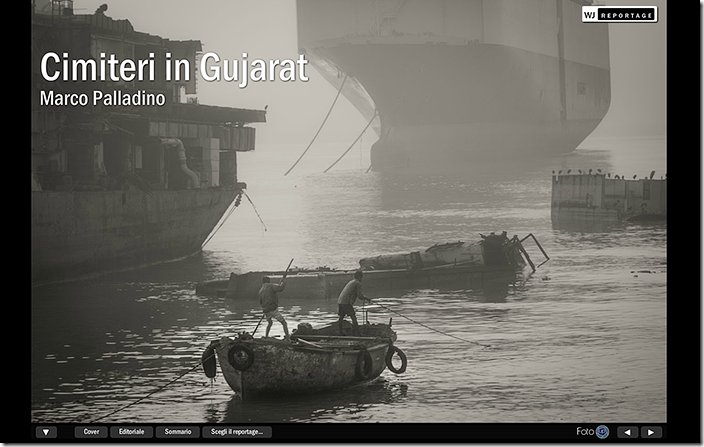
Alang is the largest ship recycling yard in the world, a kilometres-long expanse of sites where gigantic carcasses of ships are waiting to be disassembled by hand-workers, who recycle parts and components. Here are employed about 40000 workers, as much as a medium town. It’s a dirty, dangerous, exhausting and deadly job. They climb on these metal giants that stay torn apart and half-cut into the sea. They handle oxyhydrogen flames throughout the day, the air is unbreathable and saturated of combustion gasses, of oils, lubricants and acid fumes, the air is pungent, stinging, it burns the eyes and the nose. Here as elsewhere the workers are poor labourers coming from agricultural areas even poorer than here, like Bihar, Assam, Orissa, West Bengal or the neighbouring Pakistan, they flee from hunger, do not have any formal training to deal with toxic materials, are willing to make this life for the equivalent of a few euros per day…>> READ THE REPORTAGE IN WITNESS JOURNAL #59 >>

image

beach, broken, cargo, chunks, container, corrosion, damaged, discarded, disposal, dump, environment, environmental, freight, garbage, goods, heap, indonesia, industry, iron, junk, junkyard, , metal, ocean, pile, pollution, pollution, recycle, recycling, reuse, rust, rusty, scrap, scrap-iron, ship, shipping, stack, steel, traditional, transport, transportation, trash, ugly, utilize, waste, wreck, wreckage, yard

READ ALL >>>

Elegance and Dignity - Women workers from a poor village of India

Saturday, 11 January 2014
Here we present the synopsis from chapter 7 of the book “Elegance and Dignity – Stories from India”.


India is a land of extreme inequalities, with a new rich class who lives light years away from the poorest population, which is still a great silent majority. Sometimes they share the same physical space, but are connected within a logic of exploitation of labourers without any humanitarian attempt.
 
It is not uncommon that the same local government, which should protect the rights of the poor, it’s the one that exploits the people of poor villages or lower social classes for making jobs that are related to public services, otherwise too expensive, such as cleaning the streets or such as in the villages of Hawala, a few kilometers from the most sumptuous residences of Udaipur, these women, children and elderly, who do heavy work as a bricklayer.
 
These works are not only underpaid but also odd, or rather not guaranteed. If the State or a private enterprise, as in this case, has to build something, then they agree with the village’s chief and the community organizes itself. Women are equal to men when employed in heavy and strenuous labour, but they also have to accomplish all other matters such as child care and housing. Often these are young girls, who are already married at very early age.
 
Women and children of the pre-industrial villages are workers who have no qualifications or education, that means easier to be exploited and are poorly paid. Unlikely laws will ever stop this. India indeed has the world record for employment of minors.
 
According to estimates of the International Labour Organisation here concentrates the largest number of workers between the ages of 4 and 14 years old, about 44 millions according to their data, “only” 17 million, according to the Indian government.  In the villages, furthermore, the community survives in a limbo far away to modern society. They are organized in a collective manner and the work is done by all members, regardless of sex or age. They are often underpaid and strenuous work.
 
These buildings furthermore will ruin a beautiful and almost untouched natural corner a few kilometers from Udaipur, in an area around a lake that is a natural park. The logic of speculation first uses inhabitants of the areas that will soon be filled with concrete and then depletes them of the only richness that they have: the land.


© 2013 Marco Palladino – all rights reserved
 

IMG_0744
YOU CAN HELP THIS PROJECT TO CONTINUE
AND TO BE BROUGHT TO A WIDER AUDIENCE
FUNDRAISING IS ESSENTIAL TO SUPPORT FREELANCE PHOTOJOURNALISM
READ ALL >>>

Pollution and overfishing damaging the villages of fisher(wo)men in Gujarat (India)

Sunday, 8 December 2013


From chapter 4 of the book “Elegance and Dignity – Stories from India”


This is another Indian story, extracted from my book “Elegance and Dignity”, that connects tradition with modernity, but not in agricultural areas rather in the sea. These fishing villages of Gujarat, where the whole community receives sustenance from fishing, are seriously threatened by the invasion of foreign ships that make large industrial fishing. The number of species and quantity of fish are in drastic decline since several years. The community depends on this activity: as narrated by the images the men go to sea with boats often no bigger than a lifeboat, women take care of the drying process.

Once again there is an aesthetic, which also contains the goodness of these simple lifestyles. It is an hard work but very decent. The community participates in solidarity and women portrayed here have serene faces and keep goofing around while they work.

The pollution of the sea, along with overfishing are, not so slowly, impoverishing these villages of their only resource. The repercussions are also at a social level, many young people are forced to emigrate. They can not get married, families slowly disperse. Some of them will go to work as cheap laborers in various industries of Gujarat, some to sites like Alang. Children, like many others I portrayed in different parts of India, already have a strenuous work to accomplish inside the community of fishermen, in this village it is the drying of fishes, while the men are at sea.
 
Overfishing, destructive and unsustainable fishing practices are some of the main causes of the collapse of fish populations: gigantic ships using km-wide nets and machines that literally exhaust entire shoals of fish. These industrial fishing extinguishes a species at a time, then turning to the next species.
 
Rising temperatures and ocean acidification are two threats to ocean life resulting from industrial development, with increased levels of carbon dioxide as a result of reliance on fossil fuels.
 
The pollution is widespread in all the oceans. All types of pollutants generated are degrading the marine environment, not just those emitted by factories, but as well by pesticides and nutrients from agriculture, as well as sewage, plastics, toxic chemicals and oils derived from discharges, even from radioactive nuclear power plants, located near the coast.
 
Along with the environment, all eco-friendly traditional fishing communities are losing the ability to self-sustain. They ere increasingly turning to small fish species, such as the photos and the fishermen of Jafrabat refer.


©2013 Marco Palladino – All rights reserved


IMG_0075

READ ALL >>>

EOS 5D MARK3 - Noise issues at low ISO and Highlights Priority On

Wednesday, 1 May 2013
eos5d-markiii-ef50mmI have an Eos 5D Mark3 since few months, it replaced the Eos 5D2 I used in India that had partially left me because of poor weather sealing giving problems to the contacts. I always judged with some reservation the image quality of the 5d line , coming from the 1Ds mark2. These cameras do produce excellent images, but some  really bizarre problems in cameras of this level do continue to appear.
 
Already in the Indian photos, taken with Eos Eos 40D and 5D Mark2, I started to notice some strange things: the old 40D held up much better than the other when some overexposure of the shadows is applied in ACR, without altering the overall exposure. The Eos 5D Mark2 had often noise in the shadows at low ISO, even 100, a noise made of stripes (vertical banding), as the image from a fax.
 
I have not changed the Mark2  because the camera was broken, the problems with the contacts were resolved immediately by the excellent Canon Service Center in Rome. I decided to change it for many reasons, starting from the AF, a most versatile one,  but also for a significant improvement in the well-known problems of noise, at least as for these already seen in the EOS 5D2. A general upgrade in short, without waiting for miracles but certainly hoping for a more complete and versatile camera for all uses, eg. also for sport, in which the Mark2 was very lacking.
READ ALL >>>

Comparing EOS 5D MARK2 versus EOS 7D and vs. EOS 30D at high ISO (ISO6400), about noise, detail preservation, image quality, dynamic range

Friday, 7 December 2012

compared_eos_50Dvs60Dvs7D

VAI ALL’ARTICOLO IN ITALIANO >>>


Comparing EOS 5D MARK2 versus EOS 7D and vs. EOS 30D at high ISO (ISO6400),
about noise, detail preservation, image quality, dynamic range

As always I run the test in a not scientific manner but simply aiming to highlight some aspects that I think are important in determining the choice of a camera or a lens, based on my personal needs. I have to decide whether to chose as second body to my Eos 5D Mark2 an Eos 7d or keep the current Eos 30D.

I've never used an Eos 7D, I would say that it is the only Canon camera in the area of semi-pro and pro that I never had in my hands once. Given the many threads about this camera, which can be found on the net, with absolute detractors and others who worship it, at the end I started to have serious doubts about the quality of the files produced by the 7D. In general, I am convinced that too many megapixels of nowadays cameras are only an problem, and very little do to the actual quality of an image. I also wanted to see if this marketing has even gone so far as to produce a camera with a density of pixel such to be worse than a precursor as the 30D, with only 8MP. In general I do not believe this, among other things, 18MP has now become the standard for all APS-C cameras from Canon.

eos5Dmk2I read around very bad things about the 7D: that it produces very soft files, that the autofocus fails, that as you just raise the ISO it produces a lot of noise and loses details, that eventually it has an image quality equal to an entry-level camera . Well, unless my student who has just became owner of a 7D has been particularly lucky, by having received a copy better than others, or maybe just thanks to the recently updated firmware, the fact is that by exploring this camera, now I would say... bullshit!

I understand even more as much the inexperience and indeed real ignorance of many makes so that the camera is charged for their blunders. The EOS 7D's autofocus if set on maximum accuracy, in one shot mode, is as precise as a razor. The 7D does not produce files softer than other cameras when shooting in RAW and the same photographic processing is applied to images.

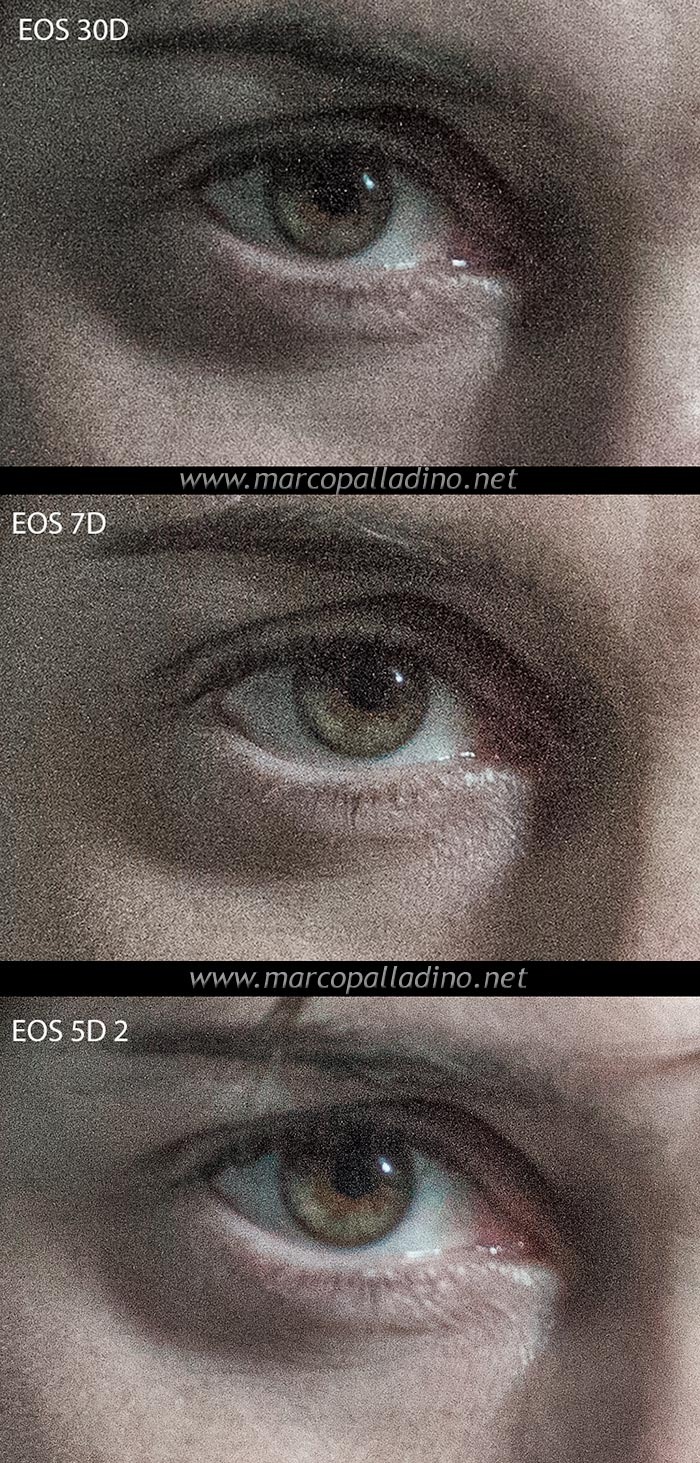
As quick test we compared the detail on the area in ​​semi-shade (left eye) of a portrait, executed with an EOS 30D, EOS 7D and an EOS 5D Mark2, at well ISO 6400. Obviously, the EOS 30D does not have the ISO 6400 but just shoot at ISO 3200, RAW, and then raise exposure by 1 stop right in Camera RAW. I present to you the 100% crop of the three shots and then I'll make my comments. As it is standard for this type of comparison, I have NOT reduced the files from cameras with higher resolution but up-resized the lower resolution ones up to the largest size, in our case, the 21MP of the eos5D, or 5616 pixels on the longest side. The crop 100% means that this image at 700px corresponds to the detail taken as 100% magnification.
30D-7D-5D2-ISO6400

Conclusions

For all three pictures we used a EF 85mm 1.8 USM @ f4, to get the best quality from the optics.

In our crop, what we see is indeed the noise from the camera set at the highest ISO (6400 ), but also the preserved details, colour and dynamic range. We present therefore the partially shaded eye  of the portrait where certain differences are more noticeable. A partial recovery on the shadowed parts guarantees to better highlight the limits of the dynamic range of each camera. The lowerer DOF of the full-frame at F4 (identical for all three shots), makes the photo of EOS 5D slightly softer (the focus is on the right eye, not the left), but I assure you that level of sharpness on the focal plane of all three shots is identical.

What you need to look at is instead the iris of the eye, the nuances of colour, the details inside. Clearly the EOS 5D Mark2 is a notch above the other two, as one might expect from a sensor that has virtually half the density of photodiodes with respect to 7D, but not with respect to 30D. The EOS 30D as old as it remains, is still a good camera. Do not be fooled by advertising, its field quality is very high even today, especially if you use good optics. Files from the 30D when enlarged can almost match with a camera like the EOS 7D, even at ISO 6400 that are not available in the EOS 30D (actually a firmware update would be enough to have them, but of course the Canon is careful not to do so).

The image produced by EOS 7D is still better than the EOS 30D’s (always look at the iris of the eye), but not the same jump that you have on EOS 5D2. This is still a great result for the EOS7D, that ISO 6400 and 18MP have less noise and more detail and in shades and colour. Really good result.

This small test teaches us another thing: if we compare a file of 8MP and 18MP the real difference of magnification is about 30% (not double as one might expect). If you enlarge a file like an 8MP to 18MP, the difference in detail is really ridiculous; such a file if correctly processed and printed would produce no perceptible difference. What are then the 18MP of an EOS 7D good for, apart from the advertising? Well we actually need those, but not if we use the photos at 100% magnification. That is, if we do not need to crop the photo since we can get optically close enough, then between 8 and 18 the difference is virtually ZERO! But sometimes crop is unavoidable, for example in the photo of fauna and for sport. So then when a file is cut 50% to 4 MP or 9MP things get very different. The 9MP file still has lot details to make large prints, the other one begins to suffer a lot, at 4MP (still usable, with the right processing).

Canon EOS 7D while doubling the number of pixels and increasing by 30% the resolution still maintains a level of noise even less than 30D, this is definitely a great achievement and I would say not at all due to the noise reduction applied by the software, the files are in fact identical in Camera Raw in terms of sharpness. On final word, the EOS 7D is an excellent camera, even if image quality is not very much better than a 30D’s or 40D’s. You choose it for many other reasons: resolution to crop, as said, but also a high-performance autofocus in sports, a great construction and excellent sealing, the flash that remotely controls other flashes, etc. etc… in short, many other things that "make the life of a photographer better". Even to use it is a real joy, much better even than EOS 5D, in comparison 30D looks as a plastic toy (it is not). But:

if you do not take pictures in rain, for sport, wildlife, etc.., and you've purchased the EOS 7D to take pictures on vacation, convinced that the hundreds of euro more you paid will ensure you better photos, then you've got a blunder, commercially induced, but a blunder. The 7D is great, but only IF you use it at its maximum, in sports and / or wilderness area, then it really pays you off. Here's how some lamentations were born!

In another test, run against EOS 30D + EF 85mm 1.8 but at aperture of 5.6 and the same pose, we coupled the EOS 7D with a Canon EF 15-85 @ 85mm and aperture 5.6 (minimum that is allowed by the zoom at 85mm). Well despite the 8MP against 18MP, the 30D+85mm prime brings out more details, or rather: BETTER LENSES PRODUCE BETTER IMAGES DESPITE THE LOWER RESOLUTION OF THE SENSOR. Mind that the EF 15-85 is a great zoom lens and the picture it produced  is sharp, but the quality that you get with a prime even on an old camera is higher, namely: EOS 30D (used) + 85mm 1.8 costs about 700 euros, the EOS 7D (used) + 15-85 almost double it. Obviously they are very different set-ups for different purposes, but everyone can draw his own conclusions.

©2012 Marco Palladino – All rights reserved

READ ALL >>>

Contact Form

Name

Email *

Message *