Content

Showing posts with label MP. Show all posts

Shipbreaking Yards of Alang, Gujarat (India)

Wednesday, 4 June 2014

From chapter 2 of the book “Elegance and Dignity – Stories from India”


Alang is the largest ship recycling yard in the world, a kilometres-long expanse of sites where gigantic carcasses of ships are waiting to be disassembled by hand-workers, who recycle parts and components. Here are employed about 40000 workers, as much as a medium town. It’s a dirty, dangerous, exhausting and deadly job. They climb on these metal giants that stay torn apart and half-cut into the sea. They handle oxyhydrogen flames throughout the day, the air is unbreathable and saturated of combustion gasses, of oils, lubricants and acid fumes, the air is pungent, stinging, it burns the eyes and the nose. Here as elsewhere the workers are poor labourers coming from agricultural areas even poorer than here, like Bihar, Assam, Orissa, West Bengal or the neighbouring Pakistan, they flee from hunger, do not have any formal training to deal with toxic materials, are willing to make this life for the equivalent of a few euros per day. For this little money they are daily exposed to arsenic, lead, contaminated by asbestos, all of which under deafening noise. In the closer village people live by sheep farming and by a related industry (recovery and distribution of spare functioning pieces of the ships). It’s like stepping back 200 years when you exit the shipyards and visit the village. But even here the pollution is terribly high.


Scrap materials, however, are a big business and thanks to cheap Indian labourers a too little costly one, and these environmental risks are not taken into any account. India, Bangladesh, Pakistan, China and Turkey are the homes of the world’s shipbreaking facilities. Every year the shipping industry sends around 600 ships of all types to be dismantled on their beaches. Workers here are totally unqualified, having very little education and are thus easy to be exploited. Workers are being provided neither with the adequate training nor with the equipment to work in such a dangerous and toxic environment, although shipbreaking is considered by the International Labour Organisation as one of the heaviest and most hazardous occupations in the world. Their general living conditions after migrating to the yards are extremely bad. Every year thousands of workers are the victims of deadly accidents at the yards of India, Bangladesh and other shipbreaking countries. The working conditions are extremely bad and safety measures hardly exist. If the shipbreaking workers don’t die or get seriously injured because of an accident, they suffer a big risk of falling ill or dying from toxic waste-related diseases.

BUY PICTURES FOR EDITORIAL USE / PRINTS


© 2013 Marco Palladino – All rights reserved

beach, broken, cargo, chunks, container, corrosion, damaged, discarded, disposal, dump, environment, environmental, freight, garbage, goods, heap, indonesia, industry, iron, junk, junkyard, lombok, metal, ocean, pile, pollution, polution, recycle, recycling, reuse, rust, rusty, scrap, scrap-iron, ship, shipping, stack, steel, traditional, transport, transportation, trash, ugly, utilize, waste, wreck, wreckage, yard, pollution

BUY PICTURES - COLOUR VERSIONBUY PICTURES - B&W VERSION
BUY PICTURES FOR EDITORIAL USE / PRINTS


YOU CAN HELP THIS PROJECT TO CONTINUE
AND TO BE SHOWN TO A WIDER AUDIENCE
FUNDRAISING IS ESSENTIAL TO SUPPORT FREELANCE PHOTOJOURNALISM


READ ALL >>>

INDIA - Preindustrial Villages of Rajasthan

Thursday, 29 May 2014

    Here we present the synopsis from chapter 6 of the book “Elegance and Dignity – Stories from India”


FULL-RES EDITORIAL PHOTOS  >>

India today exists on a multiple level including high industrialization and traditional farming communities, and this leads to a growing social gap. Talking about preindustrial society would make more than a historian upset, but this is exactly what is to be seen. Farming communities that are still in the preindustrial era, which do not know the use of machines to work in the fields and do not participate to modern life. These villages are obviously not impenetrable by modernity, which comes in the form of objects that elsewhere would be considered trash or waste. They don’t ignore what is in their surroundings. Their culture and way of life, however, are anchored to a preindustrial scheme and so are traditions, familiar and social networks, so the rules of the village and the religious codes. The people of these villages are not educated nor culturally prepared to face the challenges of the modern world in which they are increasingly going in contact. They are not able to understand the choices made at the top, by the governments, nor to politically organize themselves as a pressure group, despite the democratic principle guaranteed by the Indian system: “one man, one vote.” These communities suffer more than others the strong government interferences as a mediator of the multinational enterprises that would induce villagers to abandon traditional sustainable farming and to adopt intensive farming and OGMs. There is an invisible struggle that these villages face every day against very powerful enemies.


Despite being a desert region, Rajasthan is an area where water is abundant due to the monsoons. In the centuries the need to manage a resource on a seasonal base has created a true culture for water that is not only declined in the sacredness by which in this country waterways are venerated but also and especially into complex hydraulic systems that already the British did not completely understand and let them deteriorate. Rain is also called ‘megaphusp’ (flower of clouds) and there are at least 25 names that refer to as many hydraulic systems for irrigation and drinking water and made Rajasthan the most flourishing desert on earth. Throughout its ancient history there is not a single description of this desert as a barren and desolate land. Obviously these systems do not require electric pumps or fuel and allow villages that have preserved them to overcome the drought affecting on contrary the “modernized” villages. Traditional crops and irrigation systems have been first attacked by the so-called “green revolution”, which included monocultures of species that require a lot of water, fertilizers and pesticides; then by the large water constructions, financed by the World Bank, that have depleted aquifers. People travel miles to find a source of drinking water and it is a tragic reality that someone at home opens the taps and in a few minutes consume as much water as during one of those trips.


© 2013 Marco Palladino – all rights reserved

agriculture, Asian, beautiful, blue, building, cattle, clothing, colour, cultural, culture, destination, drinking, eco, ethnic, ethnicity, farming, greenery, head, headshot, herd, hill, Hindu, horizontal, house, India, Indian, jewellery, landscape, mountain, nature, outdoor, people, person, pond, poor, portrait, poverty, Rajasthan, rural, saree, sari, scenery, signs, tradition, traditional, tranquil, travel, tribal, tribe, valley, veil, village, water, watering, wilderness, woman


YOU CAN HELP THIS PROJECT TO CONTINUE
AND TO BE SHOWN TO A WIDER AUDIENCE
FUNDRAISING IS ESSENTIAL TO SUPPORT FREELANCE PHOTOJOURNALISM

READ ALL >>>

The "Anti-Racist Mediterranean " a sporting event against racism

Sunday, 25 May 2014

The "Anti-Racist Mediterranean " is a sporting  artistic and cultural event, whose first edition was held in Palermo in June 2008. The goal of the event is the promotion of intercultural relations between the different components that live in the metropolitan city, trying to questioning dichotomies such center/periphery and inclusion/exclusion. In this historical  moment speaking about a different kind of Mediterranean is more important than ever: the riots and the desire for liberation that comes from the southern shores of the Mediterranean is presented to the public as a problem of refugees and illegal immigrants. The Western imperial barbarism, unable to read beyond its economic and commercial interests, has skillfully staged yet another bogey of a "barbarian invasion".

PROJECT 2014

The project "Mediterraneo Antirazzista 2014" will take place in the city of Naples (Scampia), Rome (Metropoliz), Genoa (S. Gottardo - Molassana) and Palermo.
The project aims to promote an intercultural vision of our society and to break the barriers of racism, hardship and degradation through sport and cultural production, intended as a vehicle of social comparison and socialization. The six previous editions have shown that the encounter and the interweaving of relationships, in fact, brings the opportunity to meet and overcome fears and prejudices, which in most cases give rise to the phenomena of social exclusion.
The seventh edition of the Mediterranean Antiracist will be divided into two parts: "Mediterraneo Antirazzista on the road" and "Mediterraneo Antirazzista 2014".

Images show the meeting and events in Rome c/o Metropoliz on 24th May 2014

For further infos: http://www.mediterraneoantirazzista.org


© 2014 Marco Palladino – all rights reserved


GO TO THE ARCHIVE
GO TO THE ARCHIVE >>

READ ALL >>>

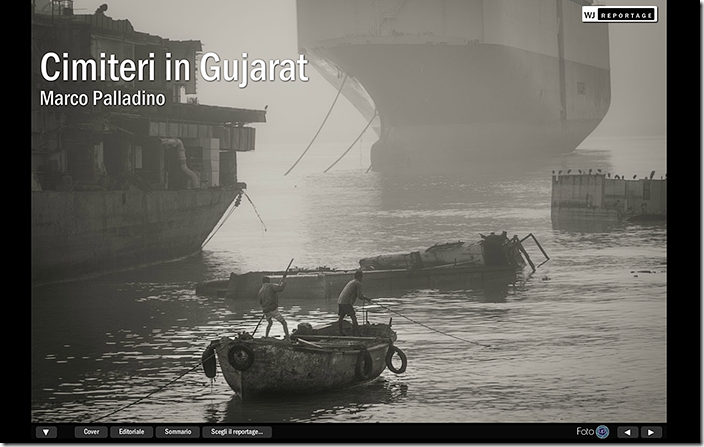
Naval Cemeteries of Gujarat (India). Photo Reportage in Witness Journal Issue #59

Wednesday, 15 January 2014

Alang is the largest ship recycling yard in the world, a kilometres-long expanse of sites where gigantic carcasses of ships are waiting to be disassembled by hand-workers, who recycle parts and components. Here are employed about 40000 workers, as much as a medium town. It’s a dirty, dangerous, exhausting and deadly job. They climb on these metal giants that stay torn apart and half-cut into the sea. They handle oxyhydrogen flames throughout the day, the air is unbreathable and saturated of combustion gasses, of oils, lubricants and acid fumes, the air is pungent, stinging, it burns the eyes and the nose. Here as elsewhere the workers are poor labourers coming from agricultural areas even poorer than here, like Bihar, Assam, Orissa, West Bengal or the neighbouring Pakistan, they flee from hunger, do not have any formal training to deal with toxic materials, are willing to make this life for the equivalent of a few euros per day…>> READ THE REPORTAGE IN WITNESS JOURNAL #59 >>

image

beach, broken, cargo, chunks, container, corrosion, damaged, discarded, disposal, dump, environment, environmental, freight, garbage, goods, heap, indonesia, industry, iron, junk, junkyard, , metal, ocean, pile, pollution, pollution, recycle, recycling, reuse, rust, rusty, scrap, scrap-iron, ship, shipping, stack, steel, traditional, transport, transportation, trash, ugly, utilize, waste, wreck, wreckage, yard

READ ALL >>>

Elegance and Dignity - Women workers from a poor village of India

Saturday, 11 January 2014
Here we present the synopsis from chapter 7 of the book “Elegance and Dignity – Stories from India”.


India is a land of extreme inequalities, with a new rich class who lives light years away from the poorest population, which is still a great silent majority. Sometimes they share the same physical space, but are connected within a logic of exploitation of labourers without any humanitarian attempt.
 
It is not uncommon that the same local government, which should protect the rights of the poor, it’s the one that exploits the people of poor villages or lower social classes for making jobs that are related to public services, otherwise too expensive, such as cleaning the streets or such as in the villages of Hawala, a few kilometers from the most sumptuous residences of Udaipur, these women, children and elderly, who do heavy work as a bricklayer.
 
These works are not only underpaid but also odd, or rather not guaranteed. If the State or a private enterprise, as in this case, has to build something, then they agree with the village’s chief and the community organizes itself. Women are equal to men when employed in heavy and strenuous labour, but they also have to accomplish all other matters such as child care and housing. Often these are young girls, who are already married at very early age.
 
Women and children of the pre-industrial villages are workers who have no qualifications or education, that means easier to be exploited and are poorly paid. Unlikely laws will ever stop this. India indeed has the world record for employment of minors.
 
According to estimates of the International Labour Organisation here concentrates the largest number of workers between the ages of 4 and 14 years old, about 44 millions according to their data, “only” 17 million, according to the Indian government.  In the villages, furthermore, the community survives in a limbo far away to modern society. They are organized in a collective manner and the work is done by all members, regardless of sex or age. They are often underpaid and strenuous work.
 
These buildings furthermore will ruin a beautiful and almost untouched natural corner a few kilometers from Udaipur, in an area around a lake that is a natural park. The logic of speculation first uses inhabitants of the areas that will soon be filled with concrete and then depletes them of the only richness that they have: the land.


© 2013 Marco Palladino – all rights reserved
 

IMG_0744
YOU CAN HELP THIS PROJECT TO CONTINUE
AND TO BE BROUGHT TO A WIDER AUDIENCE
FUNDRAISING IS ESSENTIAL TO SUPPORT FREELANCE PHOTOJOURNALISM
READ ALL >>>

Tor Bella Monaca. Urban Degradation and Social Issues. Report from an inconvenient suburb of Rome

Monday, 23 December 2013
Report from one of the municipalities with the highest demand for social services in the capital


The neighborhood of Tor Bella Monaca shows in a very large part most of the issues that afflict large segments of the population living in the suburbs of the capital of Italy. It 's a district with a unique history and specific problems, it was already born with a destiny of ghetto to house many poor families from different backgrounds and social exclusions (including many ex-prisoners) who can not afford an home and need to access the social housing.
 
Along with other areas of the Eighth Municipality of Rome this suburban district attracts a huge demand for social services, services which are in charge of the public administrations and of social enterprises who have contracted such a delicate task. The neighborhood has seen a lot of alarming situations and has gone into the headlines for many episodes of degradation and mismanagement, but it is a place that despite its problematic nature hides many valuable initiatives that are completely self-managed by the people, with the aim to culturally and socially re-evaluate this territory in which they live, and is often made, indeed almost always, in the absence of public institutions.
 
This is true in part. The Theatre of Tor Bella Monaca and other social services were possible thanks to local authorities. Government in such social frontiers like this suburb, is the only intermediate between people and municipal or national governments and oscillates between a role of single resource of vital services to citizens and at the same time acting as a serious obstacle to the full realization of important associative or private initiatives.
 
This ambiguity too often happens in this country, where the public affairs seem to be managed in an almost feudal manner.
 
Corruption is a major concern of Italy, which now lies in international rankings in positions like those of Uganda, over or around the 70th. The case of the Eighth Municipality is truly exemplary for this national moment.


Local administration in a very non-transparent series of acts has reallocated the already limited resources for basic social services such as those for the disabled people or the not self-sufficient elders, whether are these provided in the form of home or school care whether are provided in special structures that offer a more active assistance (day care centres).
 
Public money is very little today but what surprises is that in times of deep crisis such as these, in this country a very unclean use of public money still can so negatively affects basic services and skilled jobs, and local administrations do not even bother to deal with the public stakeholders. In times like these, transparency should be the top priority of any political class.
 
Obviously there is little wonder, that's still the way it is run most of the country. In places such as the Eighth Municipality of Rome - which is so starved of vital services - corruption or the simple inability to manage public money by the political class are responsible not only for paralyzing the economy but also to bring down the welfare of entire families. Families with elderly disabled children, to whom also a minimum of welfare is subtracted.
 
In the stories we present here, there is also the struggle initiated by users of a cooperative enterprise in the social area, mostly elderly, disabled or in need of vital assistance. The protest is due to the sudden shift of funds for day-care centres and other services to the person, that risk to close within a few months.
 
Several requests to meet with politicians have never been answered, thus forcing the people to occupy the municipality to get a response from the institutions. The last occupation took place on 22 October, in fact there was a risk that within a month all funds were suspended.
 
In the gallery we also present some portraits of the elderly, disabled or not, in the day-care centre, where they join various recreational and training activities, which allow them a continuous social interaction and cultural stimulus what in the solitude of the home-care they could not experience.


©2012 text and photos by Marco Palladino – all rights reserved


_N5F6580 


adult, age, aged, alone, casual, caucasian, copy, couple, elder, elderly, emotion, expression, face, family, father, friendly, generation, grandfather, grandpa, handsome, happiness, happy, intelligence, intelligent, knowledge, leisure, lifestyle, man, mature, men, old, one, pensioner, people, person, portrait, professor, relationship, rest, retire, retired, retirement, senior, seniors, smiling, space, wisdom, wise, woman, women

READ ALL >>>

Indian Portraits. From Stories recorded in Gujarat, Rajasthan, Karnataka. Preview

Monday, 29 July 2013

In January and February of 2013 I made a long journey to India in search of stories through which to tell a much visited country under a new light and in my opinion a more true one. It was the period of the Maha Kumbh Mela and I started with the desire to go to this huge religious festival, like my colleagues, to capture one of the most beautiful mass rituals of the modern age. The fate instead led me elsewhere.


I discovered the Gujarat, very little kwown by tourists and I was able to photograph an India that is very different from that illustrated on the postcards. At short a book will be published (both English and Italian) containing eight reportages and various littler stories. After that I’ll publish the photos. But here's a preview that collects portraits, excerpts from stories that will be illustrated in the book. Good vision.


IMG_8972

GO TO THE ARCHIVE

READ ALL >>>

Students’ Photo – A monthly pick among the photos sent by my students for critique

Monday, 22 July 2013

Every month or so I choose the best photo posted on the Facebook page that is dedicated to the students of the courses I held for Fotobiettivo. The selection is open to other amateur photographers who attend the group.
The photos come from a contest ina a specific topic. The winning photo is chosen by myself with advices by other photographers and various factors are take into account, such as the author's personal research, the semantic consistency, the visual suggestions. The photo may not be technically perfect, the selection is for those who are learning and the contest is seen as an opportunity to improve.

READ ALL >>>

Wedding Photography – Samples of my style.

Sunday, 23 June 2013

Samples from the last weddings I worked.
For receiving information please email me at marcopalladino@scuolafotografia.net or call (+39) 320 8937525

Matrimonio di Giovanni e Laura-34
Matrimonio di Giovanni e Laura-7Matrimonio di Giovanni e Laura-25Matrimonio di Giovanni e Laura-44
Matrimonio di Giovanni e Laura-55Matrimonio di Giovanni e Laura-69Matrimonio di Giovanni e Laura-63
Matrimonio di Giovanni e Laura-73Matrimonio di Giovanni e Laura-80Matrimonio di Giovanni e Laura-89
Matrimonio di Giovanni e Laura-101Matrimonio di Giovanni e Laura-157Matrimonio di Giovanni e Laura-95
Matrimonio di Giovanni e Laura-116Matrimonio di Giovanni e Laura-121Matrimonio di Giovanni e Laura-161
Matrimonio di Giovanni e Laura-143Matrimonio di Giovanni e Laura-148Matrimonio di Giovanni e Laura-71

EX7B0462
EX7B0019EX7B9973EX7B0027EX7B0047
EX7B0350EX7B0340EX7B0414
EX7B0440EX7B0437EX7B0454EX7B1039
EX7B0524EX7B0861EX7B1692
(slideshow with music ... ACTIVATE HD see LOW / DX)

READ ALL >>>

What a beautiful picture ... Photoshop did it? About post-production and retouch.

Thursday, 30 May 2013

ARTICOLO IN ITALIANO >>

What a beautiful picture, who knows what treatments you have made in Photoshop? Willy-nilly any photographer is today confronted with such questions. Just think about the winner photo of the World Press Photo Award 2013, the beautiful photograph of Paul Hansen, that has aroused so many reactions, as it should be, the vast majority however addressed to the editing, that many have considered excessive, and once again all complaints against the photographer, who is guilty according to many of creating drama in picture out of retouching, with an almost painterly use of light and color, definitely got in a fake way, according to many critics.

READ ALL >>>

EOS 5D MARK3 - Noise issues at low ISO and Highlights Priority On

Wednesday, 1 May 2013
eos5d-markiii-ef50mmI have an Eos 5D Mark3 since few months, it replaced the Eos 5D2 I used in India that had partially left me because of poor weather sealing giving problems to the contacts. I always judged with some reservation the image quality of the 5d line , coming from the 1Ds mark2. These cameras do produce excellent images, but some  really bizarre problems in cameras of this level do continue to appear.
 
Already in the Indian photos, taken with Eos Eos 40D and 5D Mark2, I started to notice some strange things: the old 40D held up much better than the other when some overexposure of the shadows is applied in ACR, without altering the overall exposure. The Eos 5D Mark2 had often noise in the shadows at low ISO, even 100, a noise made of stripes (vertical banding), as the image from a fax.
 
I have not changed the Mark2  because the camera was broken, the problems with the contacts were resolved immediately by the excellent Canon Service Center in Rome. I decided to change it for many reasons, starting from the AF, a most versatile one,  but also for a significant improvement in the well-known problems of noise, at least as for these already seen in the EOS 5D2. A general upgrade in short, without waiting for miracles but certainly hoping for a more complete and versatile camera for all uses, eg. also for sport, in which the Mark2 was very lacking.
READ ALL >>>

Homeless people of Rome: Urban poverty in a rich country

Monday, 18 February 2013

I just express my good wishes to you who do not have a dinner table or a roof, not even tonight, not even receive that compassion we are able to reserve to helpless animals (nothing to complain about it...), but that to some human beings is forbidden…

Around 10,000 homeless people are currently sleeping on the streets of Rome. There is an increase of about 1,000 people sleeping on the streets each year. The actual number of the city’s homeless is likely to be much higher than the official statistics due to the difficulty of obtaining a realistic estimate. Around 55 per cent of Rome’s homeless live in the area comprising the historic centre, Flaminio, Parioli, Pinciano, Salario, Trieste, Borgo and Prati, while others choose areas around the Tiburtina, Tuscolana and Ostiense railway stations. Over 65 per cent of the homeless are over 36 years old, and 75 per cent are men, according to Caritas. Of all foreign homeless, Romanians (3th and 6th pictures) the largest group (40 per cent) followed by the Polish (7 per cent) and the Ukranians (5 per cent).

Many homeless keep all their possessions with them because they obviously have no access to storage (see pic.8).  Since they have no access to or capability to get to a shelter and possible bathing, or access to toilets and laundry facilities, their hygiene is lacking. It is a very complex scenario, many are immigrants who have no money to gain a shelter and have to adapt, others are homeless in the strict sense, they had an home, they lost it. They often lost their relatives or have lost contact with them. They often don’t have a reason to remain in the society that somehow has expelled them out. Major reasons and causes for homelessness as documented by many reports and studies include unemployment for the most part.


Poverty, caused by many factors including unemployment and underemployment, is not the only reason though. It is the principle of course, often together with other factors. Lack of accessible healthcare is a big problem for people living in the streets. They often get sick and even die because of this. Italy is still a country that provides healthcare for all people for free. But in recent times these rights have been severely attacked by politicians who follow an “American” idea of privatizing all  social services. Religious traditions here very often express themselves into very conservative politics but are also the  basis for the caritative culture that takes care of such a problem almost as unique approach. Caritas and Church-related organizations  are often the only to do something. A big percentage of homeless, men and women, have serious psychiatric disorders or problems.

Disability, especially where disability services are non-existent or poor performing, is another condition to be seen. In Italy yet the support of family is very relevant, if you loose it it is highly possible that your life takes a bad direction. Welfare is not provided, just basic services are (at least, since the same is not granted in many non European countries) but it is very lacking into gaining these people to a “normal” life or even only to help for simple means of subsistence.  People, common people, voluntaries are often the only to whom be thankful, where the institutions are totally absent.

©2013 Marco Palladino


Pictures are copyrighted by M.Palladino. You can use them only for non commercial and social information oriented sites/magazines
Please insert source as following: “photo M.Palladino (
www.marcopalladino.net)” and email to inform me

IMG_8603

READ ALL >>>

Contact Form

Name

Email *

Message *